Showing posts with label Pastel Painting. Show all posts

Friday, August 1, 2014

Artist on Artist Interview with Oliver Kohls

For this month's 'Artist on Artist' interview it gives me great pleasure in featuring German pastel painter, Oliver Kohls.

A few years ago, while casually looking through some painting groups on Facebook, I discovered the work by Oliver Kohls. Kohls' powerful, brightly lit, and richly coloured pastels just leaped off the screen and I found myself immediately transported to the Northern shores of Germany - I could feel the cool damp sand under my feet, feel the sunshine and sea-spray on my face, and could hear the foaming waves tumbling onto the shore - I was hooked and wanted to know more. Kohls is also a fellow blogspot blogger. He participates in pastel competitions and his work has been quickly gaining international

And now without any further adieu here is Oliver Kohls' interview along with selected works.


Artist on Artist Interview with Oliver Kohls 
Pastel Painter


Oliver Kohls.

Polly: Hello Oliver, and welcome to my studio blog, it’s a great pleasure to have you here! Would mind telling us where your from and how you chose pastel as your medium?

Oliver: Hi Polly, thank you so much for having me here. I am from Germany and I live pretty close to the North Sea. I came to pastels by coincident. A couple of years ago I did not have my own studio and I was looking for some sort of medium that I could safely work with inside my house with four children around. So oil was not an option but once I tried pastels I was hooked. I love to work with both hands and my fingers. And as I am not very patient there are no drying times. Perhaps the only disadvantage is that you have to put the finished work behind glass.


Evening Light Baltic Sea. 40 x 70cm. Pastel. 2013.


Polly: Would you please describe your earliest memories as to when you realized you were an artist?

Oliver: I just found out, honestly. I never considered myself as being an artist until lately. I am interested in art since childhood and I painted without being asked to do so. Five years ago I was really exhausted by my job as a naval officer and my demanding family life. I needed some time purely for myself and I started painting again. It brought me back to nature as I learned to see. I could think about my next paintings anywhere, e.g. driving to work or sitting in a boring meeting (not that there are many in the German Navy). Painting became more and more important to me and beside the creation of works of art I started to study the theory of painting. People started buying my work and others were asking me to teach them the way I do it. This was probably about the time when I realized I am an artist.


Buoy in the Sun. 65 x 30cm. Pastel. 2013.


Polly: Could you tell us about your education and training?

Oliver: There is not much to say about it from an artistic point of view. I got an university degree in politics and international studies and was trained in the German Navy and the Royal Navy. This had little to do with art. But I think it helped me in planning my own way as an artist and I saw a lot of places. So I have to confess that I never received any formal art training. I read lots of art books and some of them really helped me. Another way of training yourself is to look at artwork by other artist. Sometimes when I see a painting which really touches me I start analyzing it. Why is it that the painting impresses me? Where is the center of interest? What about the values? Is it predominantly warm or cold? Is there an underlying color scheme etc. etc.? Answering these questions helps me a lot with my own paintings. The big advantage of educating yourself is that you can do it at your own pace and that you can determine what to study. On the other hand a helping hand may prevent you from going the wrong way. But anyhow as I went this way relatively late in life I will stick to my own method.


Oliver Kohls' vast array of beautiful pastel colours ....


Polly: Tell us about your influences and inspirations.

Oliver: The impressionist painters influenced me a lot. When an artist captures the light I am usually touched. My favourite artist are Joaquin Sorrolla, Anders Zorn and of course Claude Monet. Having spent many years at sea I am still inspired by the endless impressions the sea has to offer. And water and landscapes with water in it are my main source of inspiration.


Buoy at Dusk. 65 x 30cm. Pastel. 2013.


Polly: In your own words, how would you describe your style?

Oliver: My style is pretty realistic. I wanted to go the hard way from being able to handle a realistic painting towards a more loose style. And I am not even half way through it. I try to capture the sea, the sky, reflections the way I see it and the way it touches me.


Red Poppy. 40 x 60cm. Pastel. 2013.


Distel. 50 x 70cm. Pastel. 2014.


Polly: Most of your work depicts water; tell us about your connection with the water and how does it effect your artistic spirit?

Oliver: I spent almost all of my life close to the sea or at sea. I was sailing and windsurfing from early childhood and consequently joined the Navy. So I looked at the sea endlessly and was always taken by the amount of scenes the sea has to offer. This has influenced my art strongly. I think I can see if something looks right and if a mood has been captured well. A senior captain who spent all his life at sea commissioned a painting of his first ship two years ago. When he picked it up his eyes became watery. This was a huge compliment to me.


Oliver Kohls at work in his studio.


Polly: What is your studio routine like; do you give yourself a schedule to work by or do you work when you ‘feel’ it like, what is your overall process - do you work from life or from photographs you take or a little bit of both, etc?

Oliver: To me every painting is a project. It goes from viewing archived photographs, doing some sketches to the painting process itself. As I am not yet a full-time artist this seems to me a good way of doing it. Once the project has started I do not need to "feel" like it. I can continue to work whenever I have time to do so. Beside this I take my time to experiment with other mediums (oil, watercolor) and to study art books. I do the occasional plein-air but this is something I want to intensify. This mixture of producing (to sell), playing (to grow) and studying (to know) works well to me.


Marsh. 32 x 60cm. Pastel. 2012.


Polly: Tell us about the art community in Germany: What’s it like? Are there strong art communities with art associations where artists can show? Are there preferred art forms as such painting, landscape, figurative? How difficult is it to acquire recognition and gallery representation?

Oliver: Hmmm, what I am supposed to answer? The art market in Germany seems very strange to me. Access to the market is rather restricted. There are some artist communities but they are not so much organized in art forms or in mediums. It is quite difficult to get gallery representation especially if you haven't got an art degree. Realism is not very popular or let me say there are not many artist who paint realistically. I try to establish a regional footprint by exhibiting at some places. On the other hand I try to gain some international recognition by publishing articles or via the Pastel Society of America for example. Once people see my paintings I usually sell well. So this gives me hope for the future when I want to increase my production and need to increase my income.


Am Ems-Jade-Kanal. 40 x 40cm. Pastel. 2014.


Polly: Often many artists create a recognizable ‘signature’ for themselves which they maintain and rarely indulge in some artistic ideas they’d like to pursue; do you have any ideas outside of your known ‘signature’ that you’d like to explore with your art?

Oliver: Yep. I am fully aware of the problem you mentioned. And that is exactly the reason why I try different mediums and play around without the need to produce. Once you created a recognizable 'signature' there is a temptation to stick to it. I see myself on a long path of artistic development so I want to grow as an artist. Sometimes I would like to speed up the process but, I guess one needs to be patient.


 Steine im Wasser. 30 x 40cm. Pastel. 2010.


Steine im Wasser II. 40 x 60cm. Pastel. 2011.


Polly: If you could try your hand at another medium or genre what would it be and why?

Oliver: I do try oil and watercolor and I love to work with wood. I did some portraits, painted ships and I even painted dogs and cats (commissions). I do not want to be restricted to seascapes and landscapes but this is what challenges me artistically at the moment. After all I believe that it does not matter what you paint. There are everywhere similar challenges to overcome. But I think portaits could be something for me in the future.


Himmel uber dem Ijsselmeer. 50 x 70cm. Pastel. 2014.


Seagull at the Beach. 50 x 70cm. Pastel. 2012.


Polly: I’m curious to know, in your professional opinion; what constitutes as a good piece of art?

Oliver: A good piece of art to me is a painting, a sculptor or whatever that touches me. Do I feel something by looking at it? This sounds profane but I think it is not. I try not to jugde other peoples artwork but I can say what I like and what not.


 Anse de Sainte-Croix. 50 x 70cm. Pastel. 2014.


Anse de Sainte-Croix. 50 x 70cm. Pastel. 2014.


Polly: If you could have dinner with one person, dead or alive, who would it be and why?

Oliver: Vincent van Gogh. I just read a scientific biography by Christoph Arnold about him of more than 1000 pages. It is obvious that his family bended the truth after his death. Many letters he wrote or which he received are lost allegedly. It was understandable that his family and friends tried to put themselves into a positive light shortly after his death. But I think nowadays the truth would be helpful in understanding his art. And although this biography was well researched the conclusions were not always convincing to me as an artist. So although Vincent van Gogh would probably have eaten little with his sensitive stomach the conversation would have been very interesting to me.
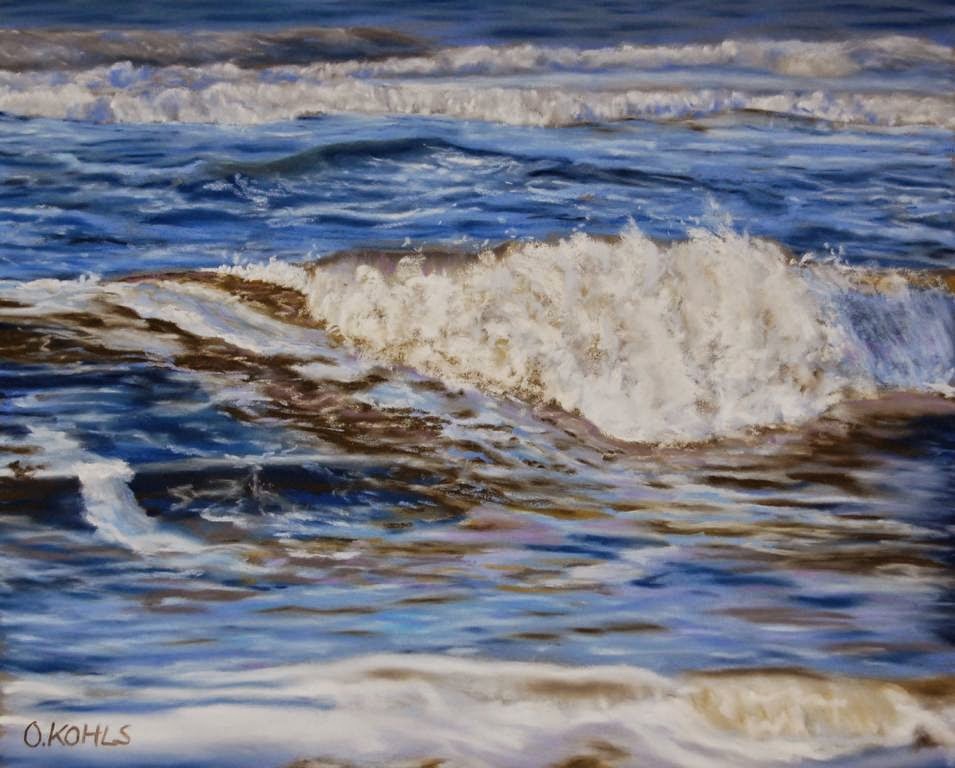


Nordseebrandung. 40 x 50cm. Pastel. 2010.


 Breaking Waves Cote Bleu. 40 x 40cm. Pastel. 2014.


Polly: Who has been the greatest support to you as an artist and how?

Oliver: My father-in-law who was a real friend to me. Unfortunately he died two years ago. He talked to me a lot about my art and life in general. He was a pastor at the Lutheran Church in Reading, PA. He rode a Harley-Davidson, played many instruments and was a piece of art by himself considering the tatoos he had. He taught me to be self-confident about my art and this was perhaps the most important lesson I learned. Self-criticism is to me the most important skill an artist should have during the painting process. But once your painting is done this has to stop which was not easy for me to learn.


About to Break. 33 x 77cm. Pastel. 2013.


  Breaking Wave. 27 x 68cm. Pastel. 2014.


Polly: Tell us what your thoughts are on being an artist and what has been the most challenging thing?

Oliver: The most challenging thing was to realize what I want to do in life. Which is being an artist. Especially as my biography is not the one of an ordinary artist. My income was reliable and secure. And now I am on my way into uncertainty. Even people who do like my art do not comprehend the step I am taking at the moment. And this although my sales figures are rising constantly. It is something one has to come to terms with oneself. But I am looking forward to it. Painting gives my great pleasure. I love the whole process and I am very satisfied once a painting is finished. Two years ago I started to conduct workshops to see whether I do like to teach painting and from September onwards I will be teaching some evening classes. And yes I do like it and people are appreciating my intuitions. But nevertheless teaching needs to be on top or next to painting.


Oliver Kohls with his pastels.


Polly: What words of wisdom would you offer to young and aspiring artists?

Oliver: Does this question mean I am no longer young and aspiring? No kidding: Trust yourself artistically, go and create! And don't be frustrated by denial. If you want to be successful economically it all comes down to non-artistic skills like marketing, planning and communication. If you get the right balance and if you really enjoy to create it will work out.


A Simple Wave, 17.5 x 85cm. Pastel. 2014.


Polly: Thank you so much for your time Oliver! And lastly, is there anything else you would like to share with us about you and or your art?

Oliver: I want to thank you for interviewing me. I hope the people who are reading this interview enjoy my answers. If by coincidence someone from the art community out there thinks my art is okay and could imagine some sort of cooperation I am up for it. Have a look at my website www.oliverkohls.com (it is in German and English) to see my paintings and contact me per email at oliver.kohls@googlemail.com. Thank you!

-------

Polly: Again, thank you, so much Oliver for your insightful interview and for sharing your work with us. I wish you the very best with your artistic life and endeavors in the future!!

And thank you to my followers for reading Oliver Kohls wonderful interview. Please feel free to leave a comment below.

Cheers, ~ Polly ~
_________________________________________________________________________________

To learn more about Oliver Kohls and to see his work please visit his web-site, blog and Facebook page.

Website: www.oliverkohls.com
Blog: http://kuestenbilder.blogspot.com
Facebook: www.facebook.com/kuestenbilder

Saturday, June 1, 2013

Artist on Artist Interview with Dave Kaphammer


For this month's 'Artist on Artist' interview, I am honoured and have great pleasure in featuring, Dave Kaphammer - Pastel Painter. The discovery of Kaphammer's work was purely serendipitous and happened through the Quintessential New England: Artists on Facebook group where Kaphammer and I, are both active members. When I first saw Kaphammer's work of 'Fire and Snow' (see the above image) - it was an experience like a moth to a bright light; I was immediately drawn to Kaphammer's brilliant use of light and shadow play, and his affinity for nature. His work inspires me greatly with its compositions that range from simplistic to complicated, its handling of the pastels, its sense of light, and, the overall intimate and connectedness to Nature. 
And now without further adieu, here is Dave Kaphammer's interview along with selected works. 


 Dave Kaphammer - Pastel Painter.

Fire and Snow - 18" x 12"

_________________________________________________________


Dave Kaphammer - Pastel Painter.
 __________________________________________________________
Polly - Would you please describe your earliest memories as an artist?

Dave - I can remember loving to draw as a kid, inspired by my Dr. Seuss books. At some point I got into charcoal drawing - my parents had gotten me a set of charcoal pencils and a drawing pad, and I spent a lot of time trying to learn to blend and work with them, without any instruction. My parents bought me Nicolaides book when I was in something like 3rd grade - it was a little over my head! I never heard of a kneaded eraser or vine charcoal till college. In school notebooks I was obsessed with drawing Harley motorcycles, cars, and a few characters I invented - bug eyed aliens, gangsters in suits. I also used to spend hours copying editorial cartoons - I have no idea why I got into that! In high school I drew pencil cartoons of teachers and students, striving for a likeness and a funny situation or caption. In college at an engineering school, I did a weekly cartoon strip in the school newspaper for two years, having taken it over from a member of my fraternity.


Warm Light on Ice - 12" x 18"


Polly - Could you tell us about your education and training?
Dave - I wasn't able to take art in high school, though I desperately wanted to, because you couldn't be in the band and take art in my school. In college, an engineering school, I took one semester of beginning drawing my senior year. Loved it, but that was all that was offered. I had no real art education until about 11-12 years ago, when I started taking drawing classes at the Worcester Art Museum. I really loved it, and took portrait and life drawing and other classes for about a year. In my last drawing class, my instructor, Ella Delyanis urged me to try pastels, her specialty. So I tried a beginning pastel class, and was instantly hooked. I loved that I could bring color into my work and still be drawing. After that I took every class offered by Ella for the next 2 years.

The past few years I've been studying with Jeanne Rosier Smith. Her work is brilliant, and she is a very generous teacher - offering up anything and everything she knows. Our evening class group has grown into a supportive artists group where we all support and inspire each other - a wonderful atmosphere fostered by Jeanne.
I've also taken workshops with several wonderful artists - my favorites were Liz Haywood-Sullivan and Marla Baggetta.


Birches on Snowshow Path - 11" x 14"

  
Polly - Would you describe your style and methods of working?

Dave - At this point, I am really trying to keep my work as loose and fresh and painterly as possible. I work mostly from photos I've taken - because I mostly work at night after work, and started out that way in night classes. I'm also very into photography, so I go out hiking on weekends with my camera, looking for inspiring scenes, and composing with the camera. I don't take notes while I'm out shooting, but I revisit the same places over and over again, and try to get as familiar as possible with the colors that are really there, since the camera doesn't capture all of it.

I usually paint quickly - I want the strokes to be visible and fresh. I mostly don't blend with my fingers, but rather try to mix colors in layers and with broken color. I always underpaint these days, usually applying pastel to a sanded surface and setting it with alcohol. For supports, I typically use either UART 400, or a blend of pastel ground, pumice, and water that I apply to acid-free matboard. I love the texture of the handmade surfaces, but sometimes I like the uniformity of the UART - it depends on the subject. I block in the major shapes with either a complement or local color, depending on how much energy and shimmer I want in particular areas, whether I want them to be the focus or to fade out into the distance. I love to finish with loose strokes and highlights - they add excitement and energy. While I do paint realistic landsdcapes, I want my hand to be clearly visible. Plus, I have a pretty short attention span, so I really don't have the patience for tight detail. I love the magic of implied detail, where up close you see just strokes and marks, and when you step back the image just comes together and pulls you in. When that works, it's really a rush for me.
Cold Drama - 18" x 12"


Polly - What interests you most (in terms of subject and theme) as an artist and why?

Dave - I've been into mainly local landscapes for quite a while. When I started out, it was mainly interesting compositions and subjects that I focused on. But the past few years I realized that all my favorite work was more about the light than the subject. I think somebody else even had to tell me that! I was focusing on the light and shadows, but didn't even realize it at first. When I became aware of it, then I really brought it out and started to take off with it - I brought more energy and feeling into my work then.
The winter before last, when we had snowstorm after snowstorm, I became fascinated with light and shadow on snow. I remember hiking one day with a foot and a half of snow on the ground and a clear blue sky, and was enraptured for hours. That winter I was so in love with snow painting, and when spring came I was totally lost! I had to figure out what to paint again.
Then I made a trip out to Crane's Beach in Ipswich MA on a friend's suggestion, and found a new subject! I loved the rocks on the beach leading off into the distance, and also the beach at low tide where the wet sand reflects the sky. So, another subject to love!
Lately I've been fascinated with reflections on water - from ponds, creeks and rivers nearby. Again I'm painting light, and I also love the abstract patterns in the reflections. It's a great subject for loosening up and getting more abstract.

Converge - 12" x 16"


Polly - People are interested in knowing what materials and mediums artists use; what do you prefer and why?


Dave - My favorite pastels are Terry Ludwigs - they are wonderfully soft, the colors are vivid and wonderful (also great neutrals!), and the square shape is perfect for so many situations! The corners can make light sharp lines, and the broad sides make for painterly blocky strokes. Sennelier makes some favorite colors too. And lately Mount Vision pastels have been great for blues, violets, and neutrals - my first was their stormy skies set. I have a few Nupastels and Cretacolor hard pastels I use for some under-painting and details.
For surfaces, I always use a sanded surface these days - mostly UART 400, and handmade surfaces I mentioned earlier. I'm always under-painting, so I need a robust support, and the sanded surface allows for many layers. The handmade surface is great for interesting textures you get with the brushstrokes of the applied medium.


Kaphammer's studio space.


Polly - If you could try your hand at another medium, what would it be and why?
Dave - I've been working at oils lately. The thing I love about oils is having the work right out there with no glass between it and the viewer. And I love working wet into wet, blending on the canvas. But man is that a complicated medium - so much chemistry and stuff to learn. I also like to play with the palette knife - it's kinda like the big strokes I can get with pastels. Loose and fun!

  
Kaphammer's pastel palette. 


Polly - Do you mainly work plein-air or do you work from photographs. Which method do you prefer?

Dave - Mostly I work from photos. I like plein-air, but I don't have much time for it. I am very aware of the limitations of working from photos,and strive to put back some of the color that is lost in the photo. Also, it's so tempting to try to render all the detail you can see in the photo, and you really have to think about what to simplify, to recompose, add or remove elements, etc. They are a great reference, but you have to be constantly aware of your own vision and not get caught up in the photo.
  
It's All About the Shadows - 11" x 14"


Polly - Would you share the story behind this piece, 'It's All About the Shadows'?
Dave - This was done from a photo that I took the day after the big March snowstorm this year. I was out on my brand new snowshoes for the first time, it was a warm beautiful day, and I was really happy to get outside. I found out that snowshoeing is really tiring by the way. It was one of those beautiful days when the sky is blue, with fresh snow on the ground, which makes for beautifully colored shadows. When I came upon this scene, I was fascinated with the abstract pattern of shadows on the lake surface, and the way they faded as they radiated out from the shoreline. I also loved how the really intense sunlight dissolved some of the shadows on the right. Most of the shadow color was remembered and invented - photos don't capture that much color in shadows. In fact, I often work from prints on plain paper or matte photo paper, both of which make for lousy photos because they reduce contrast and dull out color. That forces me to remember and invent color, which makes for better paintings.
  
Warm Light in the Cold. 8" x 6"


Polly - Please tell us about your influences?
Dave - I have a few favorite pastel artists whose work inspires me. One of my biggest influences is my current teacher Jeanne Rosier Smith, who I've been studying with for several years. She is a very generous teacher and her work is very inspiring. I've started teaching recently and would love to be as good a teacher as Jeanne.

Liz Haywood-Sullivan is a big influence - they way she captures light is brilliant. I also love the work of Elizabeth Ganji and Christine Bodnar - for their energy and looseness. Paul Shulenberg's oils are wonderful for the way he paints the cape light. Marla Baggetta for the way she abstracts the landscape,and her fearlessness as an artist in taking new directions, and following her passion.


Twilight Blues -11" x 14"


Polly - Who has been the greatest support to you as an artist and how?
Dave - That's a tough one - probably have to say Jeanne Smith for the constant positive encouragement and her ability to see the good parts of my work when I cannot. Also my friend and gallery owner Teri Canelle Eramo of Eventide at Periwinkles in Essex. She took me on when she opened her gallery two years ago, and has been a wonderful supporter of my work.

Reflection on the Charles - 12" x 18"


Polly -  What has been most challenging for you as an artist?
Dave - Finding the time to paint is the biggest challenge at this point. Also, I am really working at making my work more loose and abstract - it's a constant struggle to keep from overworking. I'm making progress, but I want to go further - constantly working to keep from falling into habit and rendering too much.
Low-Tide in Afternoon Light - 20" x 16"


Ripples - 9" x 12"


Polly - Why do you make art? Why is it important? Why Pastel Painting?


Dave - Why do I make art - that's something a friend asked me a few weeks ago, and I had to really think about it. I can't not make art. I'm happiest when I'm painting, creating, absorbed in the work. When I am painting my mind is occupied fully in just painting - no thinking, worrying, buzzing, all the bad stuff your mind usually does. It's meditation for me, something I can't live without at this point. I get a little crazy and cranky if I don't paint. I'm more into the process of painting than the end product, I guess. I mean I like to see my finished work, but then I'm just as itchy to be painting again as I was before.
Why pastels - I love the immediacy of applying the pastel - fresh, direct, nothing between me and the medium. And I love the brilliance of the color. Also it's forgiving - you can brush out your mistakes! Really takes the pressure off! That's a big deal for me.

Birch Glow - 18" x 24"


Polly - Would you say your art has changed your life and if so, in what ways?
Dave - Well, I can tell you for sure that I'm always thinking about painting when I'm out in the world. Composing images, thinking about the colors I'm seeing, absorbed in the way light is falling on trees, buildings, people. It's changed the way I see! I feel like I see beauty in little everyday scenes that I pass by every day that I wouldn't have noticed before. In fact, I've pulled the car over on the way to work to shoot reference photos numerous times. I'm so glad I am aware of all the beauty I get to notice and appreciate now that I never would have paid any attention to if I wasn't an artist.
  
Last Light on the Pond - 12" x 18"


Polly - Much of your work focuses on being outside in the woods, sunlight and shadows, could you tell us why you’re drawn to these scenes?
Dave - I love being outside - hiking, walking, running, cycling, snowboarding, etc. When I started painting, I brought along a camera for reference photos. Once I figured out that my work was about light and shadow - kind of stumbling over that fact - I now get such a charge out of seeing the beauty of light in the outdoors . It's just thrilling to see these little magical scenes everywhere - all you need is sunlight and your eyes and it's everywhere! How awesome is that? I love to paint those scenes and bring my love of them to others.
  
Blue and Yellow - 16" x 20" 
Polly - If you were conducting this interview what one question would you ask yourself and what would the answer be?

Dave - 'What is most frustrating or difficult about being an artist?'
Dealing with rejection from juried shows is something I have an ever so slight tiny little bit of trouble with. I've been entering a lot of juried shows lately, pastel only and open to all media. I tend to react very negatively when I am rejected from juried shows - thinking I'm no good, my work is just not interesting or original, what was I thinking, etc. Recently I went through that whole plunging routine when I didn't see my acceptance to two shows I really cared about, and then found out that my acceptance notices were either late or lost in email ether. So I learned that those reactions are just a waste of time - either good or bad - and that I have to just work on myself and my art and be happy with the process. Lesson learned! Then the next week I was rejected from another show, and, well, here we go again! Lesson kinda-sorta learned ...


 Creek Reflection - 9" x 12"
Polly - And lastly, what words of wisdom would you offer to young artists?

Dave - Keep painting - just paint and paint. Satisfy yourself with your work, let your style land vision grow organically - don't try to paint like somebody else. It's OK to be inspired by other artists, but don't try to imitate or force yourself into a certain style, just keep working and your own vision will develop and grow.


Winter Sunset - 8" x 6".


Thank you again Dave for this wonderful opportunity and incredible insight into your artistic Life! I wish you the very best.
To learn more about Kaphammer and his work(s), please visit his website  at www.davekaphammerart.com/


Monday, April 1, 2013

Artist on Artist: Interview with Donna Martell.

This month I have great pleasure in featuring one of my most favourite female pastel painters of today, Donna Martell. What can I say, pastel is medium I've long admired and I just love Martell's work. Her work resonates with me on an intimate level; it elicits a sense of rapture like that of a favourite memory. Her work engages the viewer with rich colours and texture, and strong compositions along with a skilled hand and eye. 
For Martell, it was through a change in circumstances and the kind encouragement from a friend that gave her the needed push to find her new found talent in pastel painting. Martell's work has been exhibited in a number of regional galleries, art associations, and museums; including the Slater Museum of Norwich and the Maritime Gallery at Mystic Seaport. She is a member of the Lyme Art Association, the Connecticut Academy of Fine Arts, and the Connecticut Pastel Society; where she won last year's honour of Award in Excellence.

In 2005, Martell had a one month Artist in Resident in the far reaches of Bulgaria through the Griffis Foundation / Orpheus Foundation.

Thank you, Donna, for these glimpses into your life and work!

And now without any further delay, here is Martell's interview along with selected images of her works. 


Donna Martell


Winter Woods.


Polly: Could you tell us about your education and training?

Donna: The shorter answer about my art education is that I took classes from disciplined artists whose work was beautiful and beautifully executed. When I saw how they drew or painted, I wanted to know what they knew. I followed where my curiosity led me.

I have no art degree. Based on my aptitude at the time, no college would have accepted me. I had always been good at writing and languages, so that’s what I studied. I wished I was able to paint every time I saw a sunset; I just knew I wasn’t any good at it. When she heard me complain about this, my friend Suzanne told me that God doesn’t give us the desire without giving us the ability, and she recommended her father as a teacher. Gerard Smith looked at my pencil scratchings and said that yes, he would take me as a student. He taught me acrylics. As time went by, I discovered Christopher Zhang, and he gave me a thorough grounding in oil painting. He also gently suggested that I learn to draw. I was buying books and reading them, especially the ones about drawing. The artist community around here (Martell referencing the Southeastern CT region) is very supportive and sympathetic, and somewhere along the line, I attended drawing classes and actually DREW IN FRONT OF STRANGERS! My teachers were Hollis Dunlop, Michael Peery, and Jack Montmeat. I also went out painting with other artists – Garnet Wrigley, Peggy Traskos, Mark Patnode, Roger Tremblay, Dave and Rhonda Weber…
I was wandering around the Waterford library, and I saw an amazing, beautiful painting hanging over the desk. I couldn’t even guess what the medium was. It was thin stripes crisscrossed to make the image. It turned out to be a pastel by Elaine Juska Joseph. When I phoned her, she asked me if I were interested in making a purchase. I told her, ”No, I’m interested in lessons.”She took me on as a private student. From her I learned the basic pastel techniques, but more important to me, I learned what magic color compliments can do. I had never heard this before, and I had never seen anybody use the information. I demanded, “Does everybody know this?!” Eventually she took me to the CT Pastel Society to drop off her work, look around, and meet other pastel lists. I knew about showing and selling my paintings, but she was my introduction to the business of art – painting, showing and selling the work as a career.
I don’t remember how I met Foster Caddell or exactly when I began taking classes with him. He dragged us all over Connecticut painting outdoors in pastel – all year long. Unless there was a blizzard or heavy rain, we painted outdoors. I can still hear his New England accent – “Don’t paint the thing! Paint the beauty! Also, “Just because a branch has a knot on it doesn’t mean you have to paint the knot!” One day we had a new student. She set up next to me and we began to paint the clothed model. The new artist was very nervous, so I was joking with her, and we were chatting – I was definitely not taking the drawing seriously. Foster came over and gently suggested how she could make her drawing of the woman’s face better. He spoke softly, offering a little color theory, and generally made her feel a little more confident. Then he whirled around, stuck his finger in front of my face and barked, “No excuse for you!” It was a learning moment.


Early Rise.


First Sight.


Polly: Would you describe your style and methods?

Donna: I work from the paper forward, meaning that I paint the big patches first then fill in the details on top. I usually lay on the colors from dark to light. I hatch one color over another in order to blend them and create the color I want, even on the first layer of big patches. I never use just one color to paint that color. I never smear colors together. I leave little bits of the under-colors, or even the paper’s color, peeping through the hatch marks above. I never use gray or black because I prefer to mix them using complimentary colors. Piling up strokes of complimentary colors, believe it or not, can make for clean, exciting shadows as long as you use pure compliments. Pastel is the only medium where you can get away with this. A pastel stroke doesn’t move on the paper. It doesn’t spread, blend, or soak in.

Lately I’ve been experimenting with limiting the color of a piece, making the whole painting from one compliment pair. I especially enjoy the blue/orange pair. Thanks to Michael Perry, I appreciate how wonderful they are for painting bare skin, and they are equally wonderful for landscapes, including snow scenes, which was a surprise to me.


Mountain View.


Orpheus.


Polly: Many people are curious to know how artists work - What materials and mediums etc, do you prefer?

Donna: I prefer a range of pastels from hard to soft - For the softest effects I prefer Sennelier and Unison, and I use the almost creamy Schminke for the softest breath of color, although all brands have their uses. I love painting on Kitty Wallis’s sanded paper – Belgian Mist. That’s about it. I wash my hands a lot and go through bottles of hand cream. A good, sturdy easel is important. I recently had to buy a new table easel because as I stroked on the pastel, the easel slowly sank backwards…My advice is to buy the best that you can afford, and upgrade when you can afford higher quality.


Patience.


Swimming.
Polly: What interests you most (in terms of subject and theme) as an artist and why?

Donna: I love the play of light. It doesn’t matter what it’s hitting. Light makes the shadows, and shadows are rich with color. Light will change the color of the objects that it hits, and I enjoy the challenge of blending colors to paint this. Landscapes with a minimal number of buildings (uh, minimal straight edges…) are my favorites to paint. After that, I like landscapes with people and animals in action. Landscape scenery itself provides a layering of color that is very exciting to try to capture on paper.


Greenhouses.


Shallows.

Polly: What does pastel painting mean to you?

Donna: It’s just dust on paper, but pastellists can create a whole world with it. I love the feel of the strokes against sanded paper. I love the vivid colors. I love blending bold, rich color to make bold, muted shadows. I love that it glows, even in the dark.


River View.
Polly: Who has been the greatest support to you as an artist and how?

Donna: My family, especially my children Dan and Kate, has been my greatest support, and not just because of cheering me on. Art supplies aren’t cheap, and I have to thank my husband at the time, Mike, for paying the art bills during my beginner years, even though back then, art couldn’t compete with the Patriots or the Red Socks. He also held down the fort while working rotating shifts when I went off to paint in Bulgaria for 4 weeks as part of the Griffis Foundation Artist Exchange.

The children participated as teachers – once in my early artist years, I had just finished an oil painting of a shoreline facing out to sea. I was very proud of it. I was leaning back and admiring myself for being so brilliant, when my little daughter came breezing in, took one look and said in a little sing-song, “Your water’s crooked.”
They participated as staff - When they were about 7 and 9 years old, they assisted materially in my process. I was painting a still life at about 10:00 one summer night, when I realized that I didn’t have a decent backdrop. I woke them up and had them hold up a blue cloth (two-man job) while I finished the painting. My last words before they went back to bed: “Don’t tell your father!” I think somebody owns this – a red strawberry on a plate in front of beautiful blue drapery…
They participated as good company - When she was older, Kate would come along to painting events, and we would paint together. Once while painting with Garnet Wrigley in a beautiful field, I said to Garnet, “I wish we had brought Kate along!” Garnet said, “Why, so she can have TWO people not talking to her?” Definition of landscape artists: people gathered in a field, ignoring each other.
Probably the most long-lasting support they have given me is by being the subjects of my work. I have an endless supply of photos of them doing what they do. I have warned my son, “Don’t ever run for public office…” You’ll see some of these at my show next March, 2014 at the Alexey von Schlippe gallery – Seated People. Kate is responsible for my having the nerve to take on such a show. I had been thinking about it, but I was a little insecure (!) at the risk involved. When I asked her if she thought it was a good idea to have a show of figures, not just landscapes, she said, “Mom, your figures are awesome!” So there you have it.

Spring Waiting Its Turn.


Polly: What has been most challenging for you as an artist?

Donna: LOL! Making painted figures that are supposed to look like the people I’m painting. I just can’t move a nose around to where I need it most.


Snow on Marsh (3).
Polly: Why do you make art? Why is it Important?

Donna: I make art because I can. It’s a miracle to me that I can. I found an old report card that had art grades of C and D…Nobody gives an F in art, so I know what those grades mean. No matter how hard I tried, whatever I drew never looked like what I was supposed to be drawing. Until I was 36, I was convinced that I could not draw or paint, and that I never would be able to. Every drawing, and every piece that I paint now, is a celebration of this miracle.


Winter Sunset (3).


Polly: And lastly, what words of wisdom would you offer to young artists?
Donna: There’s always a gap between your excitement at deciding to be an artist and your ultimate discovery of your own very real genius: that moment when you realize that everything you undertake satisfies your desire to create it. In between those two elements are training and hard work, failure and recovery – and exhilaration with every forward step.

Thank you again, Donna, for this opportunity and I wish you the very best with your art! 


Martell's work will be in the Connecticut Academy of Fine Art 102nd Juried Show held at the Mystic Arts Center. Opening reception is April 11th, 2013, 6-8pm. Show ends May 4th, 2013.

Martell is also preparing for a show entitled 'Seated People' for the Alexey von Schillppe Gallery next March 2014.


To learn more about Martell and her work, please visit her website at www.donnamartell.com